Showing posts with label Platformer. Show all posts

Thursday, 12 April 2012

Shank 2 [PS3 REVIEW] [QUICK&SHORT]

Gory-Gorgeous platformer fighter that has an awesome, tight retro control system... if you can stomach the shanking.

This square-jawed brute is our hero - Shank - who just loves to..... er..... chop vegetables?
What's It All About Then?
This is Shank 2, a 2D side-scrolling brawler where you play the part of "Shank" - a guy who loves to use knives (do you see what they did there?). This is the sequel to the extremely popular 2010 original - which impressed players with it's beautiful graphics and brutal combat.

In this outing, Shank is somewhere in South America, and there's this evil dictator who is obviously up to no good. Shank is a tough hitman, out to help nobody, but the violent struggle going on around him draws him back into action.


Grab the brute, break his arm, jump over and slash that guy with the gun....
it's all in a day's work for our boy Shank.
So Is It Any Good?
+++ Retro-Perfect Controls +++
The big draw for me to this game was the controls - they are wonderfully tight and well-designed. You use square for your knives, triangle to use heavy weapons (ranging from chainsaws to sledgehammers) and circle to use ranged weapons (throwing knives and guns). The combat rockets on at an intense pace - with enemies spawning left-right-and-centre to cut up into little pieces. 


There's some extra moves that help to get you out of tight spots (launching jumps and grab/throw moves) and these allow the combat to get very tough without feeling impossible. Add to that the wide range of environmental helpers that you can use - such as explosive canisters around the place and spike pits to smash enemies into.


Basically you're never short of ways to violently kill anyone in your path - and the game keeps things tense by having quite a high difficulty level (especially on the boss fights).


If you found the combat a bit too easy then there's a Hard Mode to try as well, with less health pick-ups and more soft squishy baddies to put your namesake to. Special mention goes to the "Survival mode", which puts Shank into a small combat arena where he must take on wave after wave of increasingly powerful enemies. There's a shop system here too, where you buy bonus items to make the action slightly more bearable - but if you are still in the mood for a challenge after the main story then there's another hour or so of play here.
You can even gross-out a friend in Co-op Survival Mode!
+++ Gorgeous Graphics... ish +++

Each of the nasty ways you can dispatch baddies is animated with bright, bloody, cartoon graphics - looking truly awesome in high-def... if a little stomach-turning. Shoot grunts with a shotgun to see them splat into pieces. Throw them into rotating blades to see them splat into pieces. Run at them with a chainsaw to see them... you get the idea.


The cutscenes are just as comic-book beautiful - but the game seems to feel the need to be brutal and offensive as much as possible - so be prepared for some guts being spilled, heads being lopped off, and limbs flying everywhere.


The story that links these all up is good enough - even though one level you traipse through a swamp filled with cannibals for no good reason other than it allowed the developers to throw in some humans chomping on human bowels. It's not really about the story though, is it? It's about being a tough-as-nails hitman who slashes people to shreds in the same way you might viciously tear up a copy of the Daily Mail.
It's not just DmC's Dante who can juggle baddies with his guns.

--- Short and Brutal ---

The only bad things I can say about Shank 2 are that the game is just a little too short to be a stellar success. The main story - even if some fights take a few tries - will be over in under 3 hours. Hard Mode is there if you want it, but there's little difference in the actual gameplay. The Survival Mode again adds an hour or so, but still isn't quite meaty enough to keep me hooked for very long.

The second negative point is that with so much video violence, it all feels just a little bit cheap. Graphic nasties are thrown in for shock value alone - but when the entire game is about carving people into grillable lumps then it comes across as a little pointless. 

Basically, there's violence because it's necessary (such as taking down an evil dictator) and then there's violence because it'll make people go "Eeeeeewwww!". I found myself feeling slightly queasy at several points in the game, and it didn't really add to the experience for me.


Conclusions
The gameplay and graphics in Shank 2 are spot on - really tight and fun to play.

The difficulty level is set just right too - so you're constantly having to make the most out of the control system without it ever feeling too hard.

There is still room for improvement though - taking out some of the "filler" violence and just sticking with a longer, more-focused campaign mode and this would be a big hit.


Feel free to post comments or contributions to improve the experience!
Any images in this review are subject to relevant copyrights and are kindly provided by: http://www.shankgame.com/

Thursday, 29 March 2012

Sly Raccoon and the Thievius Raccoonius - HD Update [PS3] [QUICK&SHORT]


The original PS2 box art.
So What's The Story Then?
This is the first title of the Sly Cooper trilogy, which were released on the Playstation 2 between 2002 and 2005, and chart the antics of a master thief raccoon - Sly Cooper - and his gang of helpful animal friends. 


This review concerns the high-definition remaster of the first instalment, Sly Raccoon and the Thievius Raccoonius. Originally released by developers Sucker Punch and updated by Sanzaru Games in 2011. In this game, Sly is searching for the stolen pages of a family heirloom - the Thievius Raccoonius - an ancient manuscript which generations of Cooper thieves have added the knowledge of their special sneaky powers and secrets. These pages have been stolen by a gang of criminal masterminds and taken away to opposite ends of the Earth - so Sly must break into each of their headquarters in turn to steal back what is rightfully his! At all times he must be wary of the long arm of the law, always trying to chase Sly down, the form of the foxy Inspector Carmelita!


This is Sly swinging into action with the foxy Inspector Carmelita on his arm.... phwoar!


So Is It Any Good?
+++ Cartoon Colourful +++ 
Graphically great, excellent use of colour and with a really vibrant, cartoon style.... but that was all from the original version. This new HD update offers a higher resolution and some very minor graphical refinement - it's pretty much the same graphics but adapted for bigger TVs.


Sly's special moves - dive bombing, quick rolling, rail grinding - are all great fun and get unlocked as you carry out robberies. Special mention goes to slow motion - this really brings out the best in the updated HD graphics - allowing you to let things smash up as you jump away and watch the action unfold at a quarter speed.


The sections where Inspector Carmelita tries to shoot you with her laser gun are particularly fun - you have to race across the level while she blows up the structures you are standing on - and when combined with the slow motion these sections look and play incredibly. 


The variety in traps and special moves is complemented by the an nice bunch of scenarios and villains - such as a Haitian swamp with a voodoo crocodile, and a Chinese palace complete with a firework-flinging panda. They're well characterised, fun to beat, and perfectly matched to the cartoon tone of the game.


+++ Glorious Platforming +++

This is a 3D platformer from the glory days when platformers rule the gaming charts. You can tell that a lot of effort was put into the design of the characters, gameplay and environments - but that was just the way we used to make games (ah, nostalgia trip...)


Early levels are nicely paced and allow you to get used to Sly's skills and try out a few robberies. Later levels are a web of platforms to cross, enemies to fend off, and traps to avoid - and if you fail at the end of the level you can find yourself having to trek a loooooong way back to continue. 


This is because the health system is archaic and punishing. By collecting a hundred coins, which are produced by smashing background objects to bits, you earn a shield to protect you from one hit of damage. Once that is gone, or if you still haven't collected all one hundred coins, then a single hit of damage and you're dead. You have to go back to the start of the level and try again.


That's not a bad thing, it means that you have to take care and not just run recklessly through the levels. It builds a sense of danger - the traps and enemies are all threatening because they can easily lead to a "Game Over".


Then we get to the bosses - they always have a sneaky change or a last-minute trick to catch you off guard - and then you have to start the whole boss fight again. No handy mid-fight checkpoints or autosaving in Sly's boss stages - you have to get from start to finish without taking any damage. Boss fights are three-tiered: the first stage is basic and you learn what the boss's moves are, the second mixes it up a bit and makes you do something slightly different, and the third stage normally has the boss do some sneaky attack (like a frog who bounces around all battle until at the last minute he starts viciously whipping his tongue around).


Again, even though they are quite challenging this is not a criticism - it makes you adapt and learn how to beat each of them - and you become a better master thief as a result.

You are aided on your quest by a tech genius tortoise and a hippo.... who drives the van.


--- Minor Sound and Control Issues ---
Some of the sounds can be distinctly "low-fi" - most of the music sounds great but certain effects can sound very tinny and unpleasant (especially when played over the music). This doesn't happen too often, but it would surely have been part of the HD update to remaster the sound as well so that it works on bigger stereo systems.

Again, a very minor gripe, but Sly can sometimes ignore commands because he is millimetres out alignment with the object you want to interact with. Rails, ledges and wires are the big culprits - leading to a lot of deaths on-screen and a lot of blood boiling in my veins.


With a game that demands you to make as few mistakes as possible, when you input perfectly correct button presses and still end up watching a raccoon plummeting to his death - you feel a little cheated.


The same goes for the two driving sections - your hippo friend takes over and you have to complete a three-lap race. The controls are so pants that these sections get really annoying - particularly when you have to try them a couple of times. Luckily you'll only be spending about fifteen minutes of your total play time in the driving sections.

Conclusions

This is a welcome blast-from-the-past - and surely a welcome addition to anyone's platformer collection. If you missed Sly's adventures the first time around then I strongly recommend you give this a go now.

Although this is a kids game, it still has enough character and depth to keep adults entertained until the end. The colourful graphics aren't quite High-Definition quality, but are functional and bright enough to make the game both fun and enjoyable.

Perhaps with a bit more time and care taken over the update to the graphics, sounds and controls then this would be a stand-out title. As it is, this is an excellent reminder of one of the PS2's treasures.

Feel free to post comments or contributions to improve the experience!
Any images in this review are subject to relevant copyrights and are kindly provided by:
http://www.suckerpunch.com/index.php?option=com_content&view=category&layout=blog&id=57&Itemid=107
http://www.sanzaru.com/wp/games/the-sly-collection/

Friday, 23 March 2012

Journey [PS3] [RETROSPECTIVE]


As an extra review for this week, I'm doing a review of the art exhibit/platformer game - JOURNEY - and so thought I would take the time to do a little retrospective of the two other PS3 titles by the same developers - thatgamecompany.

I'll go through them in chronological order, starting with their 2007 release, FLOW.


Flow is a top-down 2D strategy game where you control a little microbial fish/sperm and evolve yourself by consuming other, smaller microbes and avoiding bigger, nasty microbes. It was a very artistically-styled game, with audio effects delicately chiming in as you progressed. Controls were simple - and the presentation didn't bombard you with help text and Heads-Up Displays (HUDs) - which is rare and was very nice to see.


It began in the sort of environments as shown above ^^^ - where you were this fish-type floating creature and you guided yourself around levels until you were the biggest fish-sperm in the ocean. There was an almost "natural" or intuitive quality to the levels, you could tell that you weren't big enough to take on certain floaty things - and you were helpfully egged-on by sound effects until you eventually ate everything up. It was a very serene and pleasant experience.


The levels then progressed so that there was a greater variety of things floating in your vicinity, and a greater number of tricks required to beat them. From simple things like having to swallow them at a certain point in their floating pattern, or when you had powered up by eating a lot. Although fairly simplistic, the game wasn't trying to offer anything more. It was sort of like the game Snake on mobiles - there isn't any variety in gameplay features but the fun of floating around and beating levels in good enough.


Flow was well-received by gamers - the Flash version of the game got 100,000 downloads within its first 2 weeks of release and the PS3 version was the most downloaded PSN title of 2007. The style was colourful and elegant, and the controls were simple enough to get non-gamers interested. The developers then followed Flow up with one of the most beautiful titles ever made - Flower.


Flower was released in 2009, and stunned audiences upon release. Never before had a studio released such a fantastic display that straddled the line between gaming and art. The gaming community was united in its praise for the graphics - this could be one of the best tech demos ever created - and the impressive use of colour and animation.


You started off each level in Flower as a single stalk in a field. Every stalk of grass is animated, and blows around in the wind to absolutely stunning effect. You are then given  control of a gust of wind, and use it to blow the petals off the flower head and send them swirling through the field. There are then a whole bunch of other flowers in the field - and by swooping over them you combine their petals with your own until there is a giant, swirling mass of coloured petals that you control by the end of the level.


The game utilises motion-sensitive controls, so tilting the controller left and right swirls the group of petals left and right. Pulling back causes the petals to rocket upwards and swoop over in a loop - with each and every petal detailed and animated. Oh yes. They really did. Both petals, grass and backgrounds are drawn and displayed beautifully. If you ever need a game to silence an art critic who disapproves of gaming - forget Braid, that's still a platformer - show them Flower.


The game actually has a strange story played out through the advancement of the levels and small cutscenes at the beginning of levels. There's a very strong environmental/green message to the story, and  during the second half of the game you are tasked with activating wind turbines and smashing dark, metallic, industrial structures. It alludes to city life killing the planet and causing suffering - which is solved by getting millions of players to use 8-chipped superconsoles to burn through the night displaying the game on 500-inch super HD screens? Logical. OK so the artistic message doesn't quite work but it's still frikkin gorgeous and immensely fun to play through - technicolour swirling around, trying to catch the wind (cue Donovan track).

Then we move on to Journey, released in March 2012.


Journey continues thatgamecompany's trademark style - stunning visuals - refined, orchestral soundtrack - simple play mechanic. This time you are an unnamed, robed figure who wakes up at the start of the game in a desert and looks towards a distant mountain. Through directive cameras, the game indicates which way you should head, carving a path up one side of a sand dune and then sliding down the other side. You make your way to a large arena, where the first of the "puzzles" begins.


The puzzle mechanic in Journey concerns lift - i.e. how high you can reach. You can initially only jump a tiny amount, but through manipulation of the environment you gradually unlock the ability to get higher and higher - and the game allows you to move forwards. You can spend as little or as long as you like carrying this out - Journey is much more about experience than challenge. 


It is in this area that you learn of the game's new unique feature - one of the most novel co-operative modes ever implemented. In the game world, there are other real players who are just working through a Journey in the same way you are. Their actions affects your game world and your actions theirs. You can, if you so choose, sit back and let the other traveller take over. You can just race away and ignore the other traveller totally. If you want, you can stick with that player for the whole Journey - It really is up to you. And there's no chat function, no in-game messaging, no stats, no experience levels. Just players, interacting with the game and passing each other by on their own adventure. It's a wonderful mechanic that allows for some very unusual and touching elements of co-operation and communication between players - you have to try it to fully appreciate how it works.


The very small amount of communication possible is achieved through "shouting" - tap the circle button for a little yelp and hold it down to let out a loud, harmonious tone - or mix it up to create a strange, almost speech-like noise. Weirdly, as you experiment with the shouting function - which also acts as your main tool for interacting with the game world - you will often find that your online companion will start to "shout" back until the two of you are almost chatting. It's essentially baby-talk, yes, but it's novel to reduce your lines of communication down to semi-random noises. It feels almost personal..... as I said, it's quite weird.


You play through a few different types of environment during the duration of a Journey too - there's an underground, dark levels where you slide through sand in a sort of artsy racer game - there's a snowy setting where your character really feels the cold - and then there's the finale where you finaly ascend to the summit. 

The Journey can take as long as you want it to really, but most players will reach the summit within around 2 hours. So it's short - very short. The fun is then in going back - beginning a new Journey and seeing what else you can discover, what you can do differently, how else can you interact with other players - and just experiment!

There's a few challenges set as trophies - such as sticking with the same player throughout - so these add some focus and replay value to the game. It's certainly worth 2 or 3 playthroughs (just finished my 2nd at time of writing) and when it's release price was £10 then you really can't go wrong.

Conclusion
This is about as refined as you can make a game before it gets classed as an interactive movie or an art exhibit. It manages to be both compelling and beautiful - with gameplay so easy and enjoyable that you won't be able to resist just starting one...more....Journey.


There's really no other game like it - as unique as it is intriguing. Journey rewards exploration and experimentation and is much deeper than you may initially think.


To top it all off - it's cheap enough for it to be worth giving a go - and trust me, it's worth giving a go.


thatgamecompany have a wonderful gaming philosophy and style which shines through all 3 of these titles - and they stand out as some of the defining games of this generation. 
Well done.


Feel free to post comments or contributions to improve the experience! Any images in this review are subject to relevant copyrights and are kindly provided by:
http://thatgamecompany.com/games/flow/
http://thatgamecompany.com/games/flower/
http://thatgamecompany.com/games/journey/

Thursday, 22 March 2012

Trine 2 [PS3] [QUICK&SHORT]

Absurdly pretty, fantastically colourful game 
that ticks nearly every box.


What's It All About?
The Trine is a magical object which binds three people together and grants them special powers.  These powers will be required in order to get through the puzzles the game world presents - with goblins, trolls, living forests, giant creatures.... and a witch with a dark secret to uncover. The 3 characters brought together in this fantasy tale are:

  1. A Wizard - he has the ability to conjure objects and levitate them from afar
  2. A Soldier - he has a sword, shield and hammer to fight and throw at destructible objects
  3. An Archer - she has a bow and arrow, plus a grappling hook that can be used to swing to higher areas.
The action plays out as a side scrolling 2D-frame but 3D-graphics set-up - with extra powers earned by collecting hard-to-reach gems and beating baddies - and the story unravelled through small, sparse segments of text and a normally a small cutscene at the end of each level.


So Is It Any Good Then?
+++Spectacularly Colourful+++ The visuals are the big winner here - fantastic use of colour all around means that even the backdrops are worth a few minutes to stop and take a look at. Each scenario has its own colour scheme - with lighter and greener levels at the beginning, moving through to purple and blue mystical and aquatic levels through the middle, right through to black and red as we approach the climactic finale. It's great to see a game use such a variety of colours and settings in such a short game - it means that the environments never get boring and hold your attention for the duration of the story. The characters are funny and enjoyable enough to keep you interested as well.


+++ Co-op Physics Puzzler +++ Well I can't get enough of these - the use of clever tricks such as weighted platforms and levers that build in difficulty as the game progresses is great. You can get through the game on your own quite easily, and even using just the one character - but the fun lies in switching things up and getting a friend to join in and play along. There are some issues with the physics - momentum doesn't work properly and there's a glitch with the wizard's conjuring skill that I call the "magic carpet trick" that means you can fly through most of the puzzles in the game - but these flaws don't actually make the game any less playable. It isn't perfect but it works well enough to still be enjoyable.


--- Short and Unambitious --- The big problems with the game - other than it's a physics puzzle platformer with a buggered physics engine - are that the game is over too quickly and doesn't really take off. The story is well paced - revealing itself slowly until all is revealed at the end - but you reach that level so quickly that a lot of the suspense is lost. Added to that the lack of any real improvements over the original Trine and it means that while the game is very good - its graphical shine isn't matched in the rest of the game.


Conclusion
Trine 2 has charm, humour, great puzzles, spectacular visuals and a novel concept that makes for a brilliant all-round experience.

The game is great - and worth a play through for anyone - but the game isn't ground-breaking nor polished enough to grant it too revered a place in the Gaming Halls of Fame.


If they could double the size and number of levels, add in a few new gameplay mechanics and really go wild with the story - then the game would do the visuals justice.


Feel free to post comments or contributions to improve the experience!
Any images in this review are subject to relevant copyrights and are kindly provided by: http://trine2.com/site/index.php?page=media#screenshots

Thursday, 15 March 2012

Assassin's Creed: Revelations [PS3]

Better than Brotherhood? 
.... maybe only just. 

It was only better for me because it came with the original Assassin's Creed. 

It could be the most epic and cleverly-woven piece of storytelling ever weaved into a game - and I wouldn't know because I was so alienated 
I just didn't care any more.


WHAT'S IT ALL ABOUT?
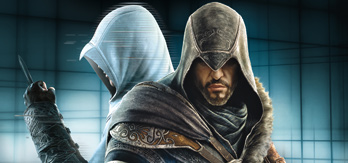
The successor to Assassin's Creed 1, 2, and Brotherhood;  this is the conclusion to the stories of Altair - the 13th Century Holy-Lander who stars in the original AC - and Ezio Autitore di Firenze - the 16th Century Italian who has been the lead protagonist through AC2 and AC:B


Both Altair and Ezio appear in-game as old men - we see Altair in his 30s, 60s and 80s, and Ezio is now in his 60s. 


For a man of 60-odd, there is little sign of Ezio Auditore di Firenze slowing up while fighting and razzing about through the game's environments - mainly Constantinople in 1511 but we also revisit our old haunt of Masyaf, Syria. The sections with Altair aged around 80 show a true frailty to the him, but it hasn't been applied well enough to do it credit - I'll explain that later.


The story set-up is still the same and the "genetic memories" of these two legendary Assassins are being played by a modern-day ancestor, Desmond Miles. Thankfully, there isn't too much of him - until you get right to the end..... anyway, let me go through things in order.


+++ O.K. - The Good Stuff +++

Much more colour - YAAAAAAY!


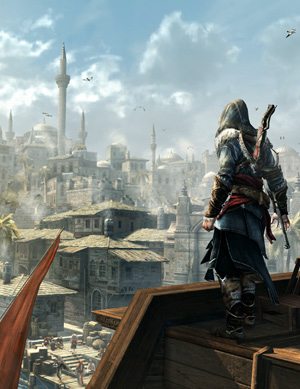
I much prefer the new setting as well. Constantinople looks beautiful - with the ornate towers, decorated markets full of carpets and other wares, crowds of people wearing vibrantly coloured robes - it it a much more satisfying visual experience. Masyaf is much the same as it was in AC1, but now is much more decrepit and so isn't quite as nice.


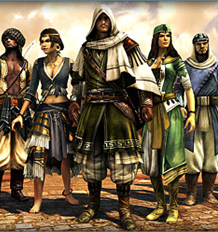
There is certainly more emphasis on the colour, variety and spectacle that's been caked in to Revelations but for the most part it pays off. Being able to kit Ezio out in a deep purple cloak and shiny new armour was at least slightly satisfying.


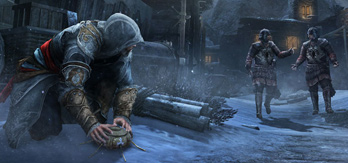
Using bombs and mines is one of the more fun hobbies in this game


+++ BOMBS! +++
Yes - OK - these were great fun. As stupid as it actually sounds on paper that people in the 1500s had bomb-making stations posted on every other street corner that allowed you to cook up a multitude of different bombs... but it was still fun to get cooking.


The bombs are good to experiment with - as there are perhaps too many bomb-crafting ingredients thrown at you (luckily not in explosive form), you are therefore able to play around and see what works for you.


Varied enough to be interesting - probably the best implemented new feature for several games. There are several types of bomb - diversionary, tactical and offensive. Diversionary simply draws a guard's attention and is made up of noisecrackers and that sort of thing. A great example of a tactical bomb is the one that is full of lamb's blood - so when it explodes onto a guard they think they've been seriously injured - and then invariable are. Finally the offensive bombs have varying strengths, fuses and effects to take out the diverse range of guards you face in the game.


+++ PLENTY OF VARIETY +++
There's lots of different enemy weapons - loads available to scavenge from fallen enemies - and stuff to buy from the shops so if you want to search for the perfect sword and lance to go with your purple cloak and shiny armour then go for it.

There's also a nice mix of armour types - guards with heavy body armour can now be fairly tough and require some good footwork or use of a bomb to drop their guard.


The variety sort of makes it through to the missions too - you spend your time searching environments for hidden objects, scaling the highest towers to unlock more of the map, defeat senior bad guys in an area to take over more control of the city. 


Side note: On the "city control" point, you can beat the captains in each area by simply sneaking close to them and shooting them. When the captain dies, all the other guards run away. You then set the guard tower alight. WIN. Yawn.


Anyway, the city is varied and interesting enough to keep you searching around for a few hours - but I don't think there's much incentive to work towards 100% completion on this one.


For added value, those who bought the game new (or had it bought for them by awesome brothers) get a copy of the original Assassin's Creed game. I mention this now because it's about the last good thing I can say about Revelations.


Here goes the rant....

What a beautiful city. What a terrible game.


--- "GO GADGET GO" AND "GOT GADGET WOES" ---
Really I haven't gotten on board with the whole gadget thing in Assassin's Creed. I've felt that the stealthy killy concept is perfectly suited to minimal gadget interference, but the game insists on offering you absolutely loads of toys to choose from - if you so wish.


There's a gun, crossbow, hidden blades, bombs, mines, poisons, throwing knives, a hookblade, parachutes (I know, wtf?) - and the developers seem to think the series will fall apart if they don't cram 3 new things in each game to "improve" on the last. Oh well - they're there if you want to use them.


So then comes my big problem in Revelations - it's bad enough that they throw in dozens of crappy gadgets. 


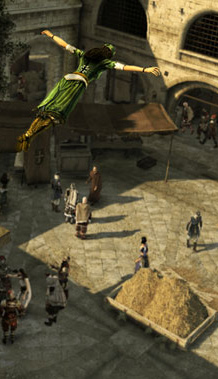
Then I give up and accept that - fine, although it doesn't fit the setting at all, I'll get on board with the whole parachute thing. Flinging myself off buildings and swooping safely to the ground saves time at least (Not that you need it because Ezio is now near-invincible and anything actually fatal can be cured with a well-timed health potion). So I start to razz around the city by parachute - getting to a high location and then just leaping and gliding down to targets was great fun.


Then - WITHOUT MENTIONING IT - you have your parachute taken away. How did I find this out? By leaping off a building to my death only to find no cloth wings of safety there to back me up. Thanks, AC:R. You have managed to successfully:

  1. Introduce gadgets that I loathe because they dilute the glorious Assassin concept
  2. Make me accept defeat - and so start to make use of said gadgets
  3. Take the gadgets away again without telling me - meaning that I died and had to restart a level from the beginning due to the lack of a parachute (for no good reason too - still don't know why they aren't present in the "Underworld" level)
  4. Piss me off. Like, seriously.


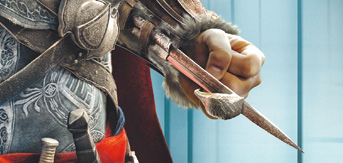
Good old hidden blades - how you served me well.


--- TOWER DEFENCE THAT SUCKS??? ---
Yes, surprise surprise, putting a tower defence mini-game in to defend your base when the enemy tries to siege it into a stealth-action-adventure game didn't work. Who on Earth thought that a tower defence mini-game would work in Assassin's Creed anyway!?!

But why exactly didn't it work? Because it was totally half-arsed. Hear me out, and I'll explain how I think this could have been awesome.


They devised a set-up that could have worked as a great, near-endless mini-game - you line the rooftops with your troops and place barricades in the way of wave after wave of incoming enemies. You also have a cannon to blast away enemies - but this is on a timer and so takes a while to reload. You can even just shoot the enemies from the rooftops with the stealthy pistol you hide up your sleeve (accurately, every single time, in the 16th Century - sure).


So why is it no good? Because it's only used maybe 5 times in your whole story play through. I think you can choose to do more - but all of the fun, variety and enemies will be sapped once you've played about 5 rounds. Actually, more like 3.


The way it would have worked perfectly is if you got to do permanent upgrades - use experience points earned in tower defence to upgrade squads of assassin's to use on the rooftops again and again. Then upgrade the cannon, the strength of your defences, the resilience of your troops - give the player more flexibility in play and make it more worthwhile to play through many more levels. 


The way tower defence games work, you could easily have it stretched over 10, 25, 50, 100-or-so levels before a "boss" came and if you beat them then you got a custom cloth dye colour unlocked, weapon, or set of armour.


It would become a meaningful part of the game rather than an annoying and redundant tack-on.... just like most other newer features in this series.


I still really like Constantinople's architecture.


--- CITIZEN CANED ---
So there's still the massive bugs present in the non-player characters in both free roam and during missions. 

Some civilians get confused when you sit on benches, walk near them or jump, and have a habit of vibrating like a washing machine for as long as you are next to them.

You are often still required to be 2 feet away from your target instantly and at all times throughout escort missions, causing serious problems when I was playing an Altair mission - he is running away from an angry mob with his son - and then the computer-controlled son hit a wall accidentally and fell down a hill backwards. I failed the mission because I just couldn't keep up with him. Mission restart. Yippee. That cutscene had so much depth and intrigue - I just can't wait to watch it again. Not.

--- FRAILTY HANDICAP ---
In some missions with Altair, you are actually unable to kill people - you have to use assassin buddies and gadgetry to help. The missions throughout are sometimes very restrictive - this actual inability to fight leaves you wondering why this was used as an action sequence in the first place.


Although the variety and change of pace is interesting, these games are now just so, so different from the original set-up of "Anything is permitted", and I feel it has lost a little something with each subsequent game. 


While I applaud them for trying to do something more meaningful and artistic in a mainstream game, I still wouldn't feel that having a soppy moment where you call in other people to shoot for you in a Call of Duty game would work. Actually, I'm pretty sure you do at some point. Alright, arse. 


Basically I didn't enjoy the aged, story sections of the game - mainly because I now feel so detached from the characters and loathe the way the story is presented that a section I may otherwise had appreciated just made me even more annoyed that I wasn't being let off the leash to go stabby stabby. That may be something in that I need to get checked out.


--- STOOOOOOOPID DIALOGUE ---
In one level you play as Altair, who has been away from his home, Masyaf, in a self-imposed exile for 20 years. As you approach, the 2 guards you are meant to kill stealthily using your hidden blade start talking about Altair:


Did you hear about that old guy Altair, who looks a lot like that old bloke down the hill?
Yeah, I heard about him. They say he used to kill people silently, using a hidden blade.
Well I don't believe a word of it.... "hidden blade".... what a load of nonsense. Oh hi, old man!

*Stabby Stabby*

WIN. Yawn.


--- CUTSCENE HELL ---
The cutscenes don't do much to help my problems with the game's story - the character models are all pretty ugly, the way they speak and move is creepily unrealistic, and they are generally either Ezio or Auditore looking soppy and old. He grunts slowly and whines about age and love and his life - and yet when it comes to crunch time and it's time to save his order he gives it all up for a woman he's only just met! Urgh. Rubbish.


Sometimes they spend a while talking about some exciting conspiracy (that I'm not exactly sure the reason you are involved) and there is talk of answers, truths and Assassin secrets.


Most of the game, though, is spent doing random errands for people - meaning that even Ezio acts and grunts exactly the same while being told to assasinate royalty as when he is told to get a bunch of flowers. Seriously, that mission is in there. 


It's that bizarre juxtaposition that ruins the game - trying to keep a player engaged in an epic conspiracy spanning centuries needs some really intense and gripping action. Revelations only lasted me 10 hours and most of that was spent watching slow, tedious cutscenes and carrying out menial tasks. Oh what epic adventure.


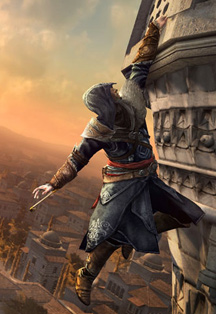
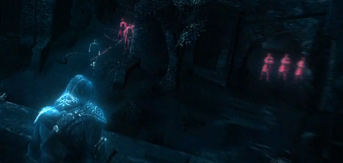
Eagle sense is still used - if a little sparingly - to detect mission targets.

--- OH GOOD GRIEF! AM I GOING TO FALL!?!?! ---
Most story missions follow the standard format: 

  • head through town, 
  • talk to someone, 
  • watch boring cutscene,
  • tail a baddie... 
  • *stabby stabby*
  • head to an underground cave, 
  • watch boring cutscene,
  • find a handhold to climb up, 
  • get halfway up and... 
  • *cinematic tense action moment!*.....*yawn*,
  • climb more, 
  • watch boring cutscene, 
  • *stabby stabby*
  • *talky talky*
  • WIN.

On the *cinematic tense action moment!* point, the developers of this are so shamelessly stealing things from Uncharted that they should put "(c) 2011 Naughty Dog" in the corner. I'm not talking about climby action stuff - that's been around for decades - I'm talking about the camera angles, animations and effects as the now-inevitable bit of scenery falls. 

It's not even slightly mixed up - the control is taken away from the player, the camera shifts to look downwards (at that scary drop that you may well fall down! Even though there's no chance because it's a cutscene). When control is returned you've already found that safe bit of ledge to start climbing up again so most of the action goes on when you're not playing. Whoopee.

--- L.A. NOIRE'S GUIDED ACTION TOUR ---
Those of you who read my review of L.A. Noire back in May 2011, would know that one of my major issues with that game was the fact that action sections comprised of you holding the "forward" button down AND THAT IS ALL. The character automatically ran in the right direction towards your target - requiring no skill and totally failing to engage the player in the action.


So why do I mention this now? Er... duh. Because Revelations does exactly the same thing. Tense, cinematic action sequences as detailed above - filled with explosions, fire and crumbling scenery - are all traversed by holding down the "run forwards" buttons. Wow. This doesn't feel like a cutscene at all.


So basically, they made the cutscenes feel like an archaic novel and the action sequences feel like a cutscene. 


Maybe the end credits will feel like a 3D first person puzzle platformer?


--- PARAGLIDING ACTION ---
Then there's a section where Ezio (no word of a lie) has to paraglide after the big baddie to catch him.


Is this really the best you can do, Revelations? You think that as a thrilling conclusion to the series should be an utterly stupid, Hollywood sequence.


When you catch the big bad, you then throw him off a cliff and battle as you fall. Well, when I say battle - you have to block ONE of his attacks and then punch him THREE TIMES


And that, Ladies and Gentlemen, is the final action in the Ezio/Auditore story. You are then left with half an hour's worth of talking and cutscenes before being treated with a baffling "Desmond" section.


--- STORIES END ---
And the conclusion to the tale? I HAVE NO IDEA. 


I can't tell if they were setting up the next game, if they trying to be all philosophical and poinant - or if it meant jack shit. 


I'm guessing at option c) Jack shit. It was awful. Just like the last 3 games, it made very little sense - had no sense of drama or conclusion - it just rambled on and then the end credits rolled. 


Now this may be one of the best story narratives ever - taking the player and 2 lead characters right to the end of the story - only for none of them to have an effing clue what was going on - but it didn't sell to me. 


Altair wasn't sure what he was doing. Ezio didn't understand a thing. I hadn't the slightest idea or care what was happening - it was a load of boring pap..... I really got bored here.


Then after the end credits there's a whole new section with Desmond in first person in a weird, Portal-esque puzzler environment. And was it gripping? Conclusive? Amazing? Game-changing?

I played through 2 out of the 5 Desmond levels and decided - No. I'm not wasting any more of my life listening to this crappy story. You know what, I don't care any more.


For the same reason, I didn't carry on with the multiplayer section of the game either - it was trying to keep you hooked by providing more details on the backstory and throwing in hundreds of useless gadgets - and I couldn't care less any more. 

Too much talky, not enough stabby. 
Disturbing but decisive. 
Revelations was no revelation at all.


CONCLUSIONS
It took me three whole games to get here but yes - I have finally given up with the Assassin's Creed series.

The new features add very little - and the fact that the new scenario is nice should make for good DLC - not a full priced game.

The conclusions to the stories of Ezio and Altair made no impact upon me - mainly because I lost touch with both characters a long time ago. I doubt I will be finding out what happened to Desmond in the end, either.

I do not mourn their passing - but out of respect for the original I will offer them this:

REQUIESCAT IN PACE


Feel free to post comments or contributions to improve the experience!


Any images in this review are subject to relevant copyrights and are kindly provided by: http://assassinscreed.ubi.com/revelations/en-GB/game-info/index.aspx